Louisa actually has her own misgivings to overcome: is she only idealizing things? Heinrich does look a lot like his son, with whom Louisa was previously in love with but whom she later found fully disappointing. No, insists Louisa. Heinrich is a man of foundation and character; actually, he has exactly the type of personality that Eric lacks, and, in Louisa’s opinion, will never be able to develop.
But Heinrich replies that he is still way too old for her. He clearly shows signs of conflicted thoughts. He doesn’t want to see her marrying a “father figure” – she still has her entire life ahead of her.
Louisa can do nothing but smile in response. She doesn’t want a “father”; she wants a husband, and she doesn’t know anybody else that could compare to Heinrich.
She wants him.
Yes, these are my words. But thank goodness, this is not my writing. Someone that I met on campus one day “hired” me, so to speak, to translate a proposal for a TV-show. The show is intended for German television (German title: “Rennfieber”), and is technically speaking made in the genre of “romantic-drama”… in other words, it’s a soap. Really, the soapiest of the soaps: a love-story involving a beautiful young goddaughter and, believe it or not, horseracing.
Sappy story aside, I was surprised at how interesting it was to translate. I was translating a German document into English, much easier than the other way around. Just to think of how to translate German Redewendungen, expressions, was a really cool exercise because when we say them in English on a day-to-day basis we don’t really think of them as anything worth putting into writing. That was probably the hardest part: kaltschnäuzige Schnösel for instance, which has something to do with pig-snouts. I translated it in the end as “cold-hearted”, which is not quite as descriptive and visual but it still gets the point across. Luckily my roommate Anna’s mother, who spends a lot of time around horses, happened to be visiting. She helped me with some of the horse vocab such as “breeding” and “thoroughbred”, very big help since they weren’t in my dictionary. Unfortunately, every paragraph-long sentence in German takes three or four separate sentences in English, so I was worried that I was straying from the content when I wrote shorter sentences.
Around 15 hours later (over a few days, don't worry) I was done with the twelve-page text. Who knows if it’ll actually make it to the “small (TV) screen”. But damn, now I want to know who will fall in love next…
Friday, December 12, 2008

a night of fortune-telling and wodka
 Breslau was beautiful and far warmer than Berlin. Robert and I went to that bizarrely sparse city-museum on Saturday that I mentioned in another blog-entry. We spent time in the altstadt (old city) that afternoon, working at a dark candlelit café before drinking mulled wine at the Christmas market and going out for pizza. The next day we went to a different café where they had delicious and untraditional borscht (beet soup) and then we walked a bit along the river just as it was getting dark.
Has anybody every heard of St-Andrew’s Day? Anybody who knows anything about Scottland perhaps? Well, I’m still not sure how it made its way to Poland considering it skipped some pretty major countries in between: France and Germany for example, which do not partake in these traditions. But in any case November 30th is a charming holiday of superstition and hospitality. The main idea is that on no other day but St-Andrew’s day do fortunes become true. Girls play different games to find out who they will marry, what his name will be, what they will do when they’re older, and more.
We were invited to a St-Andrew’s day party that night. Robert’s Tandem-partner (a sort of language buddy organized by the university), Kasia (pronounced Casha), was nice enough to invite the both of us to her apartment. She lives in a part of Breslau that Robert had never been to before; unlike some cities she said that students are spread out and do not all live in one area. She explained the traditions in German so that we could partake in the festivities too!
 We were eight people, and there were eight balloons hanging from the ceiling lamp when we arrived. Our first “activity” was to pop a balloon with a needle and read the fortune inside. Of course they were in polish, in very dainty girl-writing. They all agreed that I should go first (being the female guest) so one of Kasia’s roommates read it for me, much better than having me butcher the polish language by trying to sound it out. They all giggled while she read it. I looked around asking, what? What? What does it mean?!? Apparently it had something to do with expanding my family… I will not repeat the exact translation ☺ Robert’s fortune, I believe, had something to do with having luck in travels… He will have to buy a large suitcase because he will be traveling a lot in the future. In any case, even the two guys joined in and popped a balloon, and Robert and I were pleasantly surprised that even the guys were having fun with it. Robert commented, where else would a bunch of students keep up these sort of silly cultural superstitions even after moving away from home?
Of course the evening began and ended with vodka, lots of vodka. Good vodka, too. A little less burning and a bit more taste, or at least the little bit that I drank...
 The two guys offered Robert shot after shot, and he said he would have been ashamed were he to turn them down (it’s not bad when girls do it, but he just had to oblige them…). About six shots later we started the second “activity”. Kasia brought in a big bucket of cold water, and her roommate followed with a pot of something blue. She also brought an old key with a ring on the top. Hmmmm... key, cold water, blue liquid.... I had no idea what we were going to be doing. One by one we poured the wax, carefully so that we could do it through the ring on the key (I guess it had mysterious powers, being an old key and all), into the cold water. We let the blob cool and then took it in our hands. Against a candle, we tried to guess, “interpret”, what shape the shadow of the blob made. Somehow this translated to a fortune, but I didn't quite catch how. Robert’s looked very much like a fish. Mine looked very much like a blob, especially since I was not as meticulous as the others about pouring it through the key (lack of skills). I said that it was a starfish to stick with the ocean-animals theme.
We heated, added some orange peels to, and then drank the bottle of gluhwein that I had brought from Berlin and of course the guys offered Robert more vodka. For a few hours we just chatted in German and English and some Polish
 (not me, obviously), just sort of eating and drinking and chilling. Kasia, who is working on her masters in Germanistik in Breslau, told us about her thesis, and how much easier it is to study literary expressions in a foreign language than in one's native language. Our spoken-German was at about the same level, although clearly after writing a 40-page thesis in German on idioms and expressions her written skills far surpass mine. But just hearing about life at the University from her perspective was something new. In general it was our first time really spending time with Polish students, and finally we got a sense of the polish-styled hospitality that we have so often heard about but never really experienced.
After St-Andrew’s night I understood much better why Robert wanted to come to Poland in the first place. As a final example of their friendliness, they insisted on accompanying us to the tram stop in the freezing cold when we were heading home. Luckily we did not have to wait very long. The tram that was supposed to have come in twenty minutes chose to come fifteen minutes early (typical, according to Robert). Kasia promised to have us over again, and even give us a tour around her hometown, which is an hour to the south of Breslau.
This night also convinced Robert that Breslau would be drastically different for him if only he could get out of the dorms, which have been invaded by a particular philosopher-of-the-Northern-enlightenment, commonly known as Erasmus. And what I call "Erasmus-English" is not a very pretty English (but very, very funny: see Robert’s blog, robertinpolen.blogspot.com). So the apartment search for Robert continues… and I am looking forward to going back to Breslau a few more times next year.
my epic ride to Breslau
What happens when the famed German-punctuality “breaks together”, a german expression meaning that it essentially, well, fails? Getting to Wroclaw was quite the adventure. It is a story of my own frustrations and of friendly passengers (and incompetent railroad attendants) willing to help along the way.
 Here’s where my adventure began: at the train station in Berlin. I headed to the Berlin Hauptbahnhof right from university. My last class of the week was over, and although I was tired I was really looking forward to seeing Robert again after a few weeks apart. Of course I always welcome a trip too, and like Budapest there’s still a lot that I want to see in Breslau/Poland.
More funny stories ensued. I noticed that he had labeled me as an “Auslander”; in other words, he spoke to me of Germany as if I was completely new to the place. Right before we arrived in Breslau I mentioned that my boyfriend comes originally from a small town in the southern part of Brandenburg. He turned to me a bit surprised and with a big grin. He said, so he’s an East German, this boyfriend of yours! I confirmed that he is in fact an east German and is only in Heidelberg to study. All of a sudden I perceived that he was proud to be driving me, someone who can appreciate an “Ossie” enough to be in a relationship with one. At one point he said, they are nice, those east Germans, aren't they? Rhetorical question.
Here’s where my adventure began: at the train station in Berlin. I headed to the Berlin Hauptbahnhof right from university. My last class of the week was over, and although I was tired I was really looking forward to seeing Robert again after a few weeks apart. Of course I always welcome a trip too, and like Budapest there’s still a lot that I want to see in Breslau/Poland. I had decided on taking a train that stops twice in Germany (in Cottbus and then in Gorlitz, both cities in the incredibly under-populated province of Brandenburg). I did this in order to avoid having to switch trains in Poland, where the English and the German is, how shall I put it, either lacking or incorrect in most train stations. I had taken this train the last time, and, other than the eeriness of the pitch black and empty ride from Gorlitz to Breslau, I had had no complaints.
Melissa was punctual. Melissa was on platform 12 with her bagpack and schoolbooks, patiently watching other trains go by and other passengers embark. But for her there was a “Verspaetung”, apparently due to mechanical difficulties. The first announcement mentioned a ten-minute delay. No problem, since I would have had twenty minutes in Cottbus to get on the train to Gorlitz. But then fifteen minutes later I began to panic. I went to an attendant dressed in a red and blue Deutsche-Bahn uniform. I explained to him my problem, that I might not make my next connection. He said that there was nothing he could do. Hmmm. I asked if there was something that I could do, since apparently he couldn’t do anything. After a few seconds he said that I could tell the attendant on the train and have him/her call ahead to the next train, and see if it would wait for me for a few minutes. But there was no guarantee of that, he added.
I was beginning to notice a trend of ‘no guarantees’ that I was not very happy about. I said that if I knew now that the train would not wait for me, then I would just stay in Berlin instead of landing in the middle-of-nowhere in Brandenburg. He recommended that I find the attendant as soon as possible when I get on the train and then I could still get off on the other side of Berlin, if the next train won’t wait. Again, lots of “if’s” in this equation.
Okay, the train finally came and I got on thirty minutes later than I expected to. Much to my dismay, the train was packed. I should have known; obviously Friday night is when all the commuters leave the city for the weekend. But I eventually found two seats where I could put my bags and sit comfortably. Ever the problem when one is traveling alone – how could I find the attendant and keep my prized seats at the same time without getting my stuff stolen? The first nice lady of the evening sitting across for me offered to keep an eye on my bags, so I took my laptop with me and went on a hunt. About ten minutes of people grumbling at having to move to let me pass by later, I found her. She was too busy with the crowded passengers to notice me, but then I got her attention. She looked at my tickets, noticed that I was not just commuting but heading to Breslau, and said that she would call.
I struggled to get back to my seat but I thought, well, at least everything is under control. I took out my computer, I took out a dictionary, and got started on some work. I texted Robert to say that everything was figured-out. About 30 minutes away from Cottbus, where I was supposed to get off, they announced that because of the delay the train’s final stop would be Calau. Hmmmm. I had no idea where that was, and only cared that it was not where I was supposed to be going. I called Robert again, this time stressed and near-tears. He calmed me down; there was nothing to do but just try to get to Cottbus. There at least I could find a hotel or a place to stay for the night, and then I could think about either going on to Breslau or heading back to Berlin in the morning.
A huge mass of passengers got off the train in Calau, including a large group of loud and impatient high-schoolers. Perfect. There was one particularly "over-sized" attendant standing on the platform and, as expected, he had no solution to my problem. In fact, almost ironically he said that one should know never to take the last train of the day. That was his solution. Luckily another stranded passenger overheard me and said that I could at least have the conductor sign a document confirming that there was a delay. That is so unbelievably German - when in doubt, get it in writing, even better with an official stamp and a signature. Well, having a record could not hurt, and I joined a line back in the stopped-train to get a confirmation.
An hour later, after the high school group finally dispersed and quieted down a bit, the next train came to bring us to Cottbus. Crowded, as expected. There was a line of around five people at the Deutsche-Bahn service point in the Cottbus train station. One had left a piece of luggage behind on a different train, luggage that had a hundred-year-old dollhouse in it. He and I waited together for a while and he explained to me that the dollhouse was supposed to be a present for his niece. A lady greeted us and believe it or not…. she had a smile on her face. Thank goodness. He explained his situation. She had us wait a bit longer, and said that she would make a few phone calls.
Finally, things were looking up. The lady got a hold of the train that had the man’s luggage in it; it would be coming back to Cottbus and he could hopefully look for his luggage himself. I was hoping for similar news when I asked her - pretty much exasperated at this point - if she could have the Deutsche-Bahn find me a hotel room in Cottbus and, if possible, pay for it. She looked at my ticket, and said that she was sorry to disappoint me. The Deutsche-Bahn rarely offers people accommodation. Well, is there a train back to Berlin tonight then? I asked. She must have read the disappointment on my face. I’ll see what I can do, she replied. Again, calling a few people.
About ten minutes later someone called her back with a definite answer. No, they could not pay for a hotel room. But they would….. send for a taxi to pick me up. What?!? A Taxi?!? She relayed this information to me, and I said that that would not help, since I would be just as stranded in Gorlitz as I was in Cottbus. She clarified, not to Gorlitz, but to Breslau. I was shocked. You mean, a taxi to Breslau? They do that? She was not sure if they could find a taxi-driver to cross the boarder late on a Friday night. One more call, and then it was decided.
She filled out a certificate (with stamp and signature) confirming that Deutsche-Bahn would pay for a taxi to bring me all the way from Gorlitz to Breslau, a little under 200 kilometers. I just needed to take the train to Gorlitz, and then the driver would wait for me outside the station.
I was elated, and related the news to Robert that I would make it to Breslau after all. The man who was waiting for his dollhouse suitcase invited me to hot chocolate, since we were both getting on the same train. I could breath much easier on the way to Gorlitz, and it didn’t even occur to me that a ride with an unknown taxi-driver late for such a long distance could be a sketchy thing.
So I rode to Breslau in style. A taxi-driver with a very heavy Saxony accent was, in fact, waiting for me. I considered hiding in the back seat and trying to sleep a bit, but right away he offered me shotgun and we started to chat.
I hate to call them tales, but that’s exactly what they were to me… he told me "tales" of the good-old-times and the not-so-good times growing up in the DDR (what in English is called the GDR, the German Democratic Republic). He told me about his mandatory years of service in the DDR military, about how he smuggled in six bottles of liquor and hid them in paint jars. When the officers suspected something, he was made to stand outside from 3 in the afternoon to 1 in the morning with no breaks as punishment. But the officers found no liquor and he didn’t confess, so the next night he and his buddies got drunk and partied. That was just about his only fond memory of his army-days, however. We talked a bit about politics. He emphasized that even working-class families in Germany (like his, I presumed) could have a good political discussion. Then our conversation went to Poland. He had not been in Breslau in over thirty years, he explained, although he crosses the boarder quite often to bring German businessmen to polish brothels.
More funny stories ensued. I noticed that he had labeled me as an “Auslander”; in other words, he spoke to me of Germany as if I was completely new to the place. Right before we arrived in Breslau I mentioned that my boyfriend comes originally from a small town in the southern part of Brandenburg. He turned to me a bit surprised and with a big grin. He said, so he’s an East German, this boyfriend of yours! I confirmed that he is in fact an east German and is only in Heidelberg to study. All of a sudden I perceived that he was proud to be driving me, someone who can appreciate an “Ossie” enough to be in a relationship with one. At one point he said, they are nice, those east Germans, aren't they? Rhetorical question.
It was incredibly sweet, and when we drove up to where Robert was waiting for us by the dorms he got out of the car and gave him a warm handshake. Robert’s worries of me traveling in the middle of the night with a stranger subsided, and finally I had made it to Breslau. The best part about it is that I had bought my original ticket for just 20 euros; my ride cost the Deutsche-Bahn, however, over 200. And Robert remarked that I arrived only two hours later than expected!
So, what sort of moral could we take from this story… don’t ever take the last train of the day and expect it to work out…? Try to avoid boisterous high school groups however possible? Or maybe, that punctuality and making sure things happen on time is still a major value here in Germany. It’s not just a stereotype. As Robert has said, if that had happened in Poland, there is no way in hell that I would have gotten a taxi-rebate. They might offer you some vodka though, as compensation.
So, what sort of moral could we take from this story… don’t ever take the last train of the day and expect it to work out…? Try to avoid boisterous high school groups however possible? Or maybe, that punctuality and making sure things happen on time is still a major value here in Germany. It’s not just a stereotype. As Robert has said, if that had happened in Poland, there is no way in hell that I would have gotten a taxi-rebate. They might offer you some vodka though, as compensation.
According to the other people waiting with me at the service point, the reputable Deutsche-Bahn (think important, like Amtrak or Rail Canadian) has been slipping in the past ten years - delays and technical difficulties are not rare. So it goes both ways. Germans have a very high expectation for Deutsche-Bahn and the punctuality of the trains. And when it does not meet those expectations, the company goes through great lengths to make up for it. In any case, even after all that they have not lost me as a customer. More about Breslau soon…
Thursday, December 11, 2008
HANG ON YOU'RE ALMOST THERE
From what I've been hearing, crunch time is at its worst right now for those in Chicago working on their finals. Extreme doses of caffeine, staying up until four in the morning, sleeping for two hours, and then getting mad at oneself for having slept through the alarm... oh how I do not miss those weeks of pain. I'm sending as much virtual strength as the internet will carry and holding my thumbs/crossing my fingers and wishing you all the best! A special shout out to Miss Morgan: it'll all be over very very soon!
Szia and Czesc!
As mentioned, my last two weekends (three actually, but more about that later!) were spent in two drastically different places, similar only in their incomprehensibly complicated languages and the fact that they are both nothing like Berlin.

Budapest and Wroclaw. In the first, one cannot ignore the long history of a grand empire; the statues of the strong catholic kings of the past bordering the “heroes square” answers the question as to how a country of 11 million could have maintained such a national identity throughout WWII and the iron curtain. And then there’s Wroclaw, struggling to create a national/Polish identity after years of being, well, German. The city center is beautiful, but when we went to the “city museum” in the old town hall we learned nothing, nothing of Polish history aside from a stint about a city-theater and nothing about the German occupation aside from a portrait of Friedrich William III sort of hidden in a corner.
 Of course both of these perspectives have fascinating histories. And needless to say I had a great time in both places. It is unfathomable how much there is to see within a few hours from here.
In Budapest my knowledgeable host Mr. Milan Kidd provided me with a little snapshot into his life abroad. He lives in a really lively part of town called Blaha on the flatter, Pest side of the city. Incredibly well located, we could get to it in roughly 40 minutes from the airport via train and tram after I arrived Saturday morning. Not being able to understand a thing in the crowded-tram was certainly disorienting, but Milan said “bocsánat” (excuse me) in my place when I knocked into little old Hungarian women with my bag pack. He shares his apartment with two incredibly funny French guys (who were really patient with me when I mixed my French and my German!) and two Hungarian students, one with a really heavy British accent when she spoke in English.
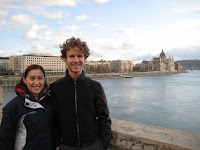 Budapest is in and of itself a highlight. But, to make it all easier to
explain I’m going to mention just a few of the things we saw and did during my visit.
On Saturday afternoon, Milan and I took the tram to the bridge to see the unbelievable parliament building over the Donau. It was my first sunshine in a couple of weeks (remember, Berlin in the winter = grey). In a span of about five minutes, everything sort of disappeared from view; we could barely see ten meters away! The snow clouds literally came out of nowhere and dumped thick flakes all around us, hiding both Buda and Pest in fog. Our first snow of the season, and we were not dressed for it, particularly Milan, who, as expected, sported his thin but well-made (shameless promotion) and waterproof Five gear.
Here's a before and after shot:


The snow came and went throughout the weekend. On Saturday night we followed Milan’s roommates to a bar right around the corner. The place was smoky and full – the perfect atmosphere for a jazz concert. The band, called Cabaret Medrano, just had a sort of character that I cannot quite describe. The pianist was astounding, along with the drums and all that with a sprinkle of accordion made for a really unique and sultry sound. One guy was so excited as he was playing the trumpet that he just started jumping up and down. And the fact that I could not understand the lyrics made it unbelievably exotic. Milan’s girlfriend Dori translated a few lines for me, but some lines she did not want to repeat in English; she said in general the lyrics were quite vulgar and incredibly funny. Ask me for the CD sometime, I’d love to share it.
 After a long (but great) day of wandering around Buda, seeing views from the castle, and successfully avoiding snow squalls, we went out to a Bavarian-Hungarian restaurant with some people that I had met in Heidelberg. I was incredibly excited to see them again, and surprised, too, that getting together worked out so well (we planned it a couple of months in advance). Eva and Andros were with me in my language course in Heidelberg, and Reka was a fellow
camerawoman for the International Ferienkurs “video production”. But also I couldn’t help but be proud A) to speak some German again after a few days of not being able to understand what people were speaking around me, and B) to be the one to introduce Milan to some cool Hungarians rather than the other way around. Spaetzel follow me everywhere. My favorite German food is Kaesespaetzel and of course there is a Hungarian equivalent, galuska, which I had for dinner. The food was too heavy for dessert, so we went to a cheap bar nearby and played some fooseball (csocso, sounds like chocho). It was sad to say goodbye, but somehow I’ll see Eva and Reka again soon.
We made plans with Andros, who is already an orthodontist and only teaches during the day, to go skating the next afternoon. The snow was still falling heavily, which made for slow but steady gliding on the ice. The rink was beautiful, under lights since it was already dark out, and with a large castle made for a past World Expo in the background. Although it was Milan’s first time skating, he picked it up right away. I was the one that fell, probably in the midst of trying to show off my sweet (and nonexistent) ice hockey skills.
We made plans with Andros, who is already an orthodontist and only teaches during the day, to go skating the next afternoon. The snow was still falling heavily, which made for slow but steady gliding on the ice. The rink was beautiful, under lights since it was already dark out, and with a large castle made for a past World Expo in the background. Although it was Milan’s first time skating, he picked it up right away. I was the one that fell, probably in the midst of trying to show off my sweet (and nonexistent) ice hockey skills.
While skating:

Later that night Dori brought us to a “Tea House”. I leave that in quotes because it was more like a tree house than a tea house, literally three levels of carpeted platforms with ladders. It was sort of like a structure for cats to play on except that it was human-sized (obviously), with dim lighting and oriental textiles hanging from the ceiling. There were shelves to take your shoes off by they entrance. Very cool, and of course the menu featured about ten pages worth of every tea imaginable: black, green, herbal, even white and red. The cookies, as Milan found out, were rather disappointing, but the ginger-peach and white tea that we drank while lounging on pillows certainly lived up to expectations.
 Of course I left Budapest with a long list of places that I still want to see, not to mention places that I would enjoy revisiting, and exploring a little more. We hardly spent time in the touristy sections, since Milan has a nose for the more worthwhile off-the-beaten-path locales. I really want to spend more time in Buda, with its staircases and steep cobblestone streets (that are no place for high-heeled boots in a snowstorm). Another big thanks to Milan, whom I will hopefully see again in the spring, either in Budapest or here in Berlin.
A few words that are useful to know in Hungarian (and some that are not so useful):
szia - hello/goodbye
koszonom - thank you
kosi - thanks
kerem - please
nem ertem - i don't understand
lassabban - slow down
ajto - door
ajto takmukodtetesu - remotely operated door
boscanat - excuse me
bosci - sorry!
szamitogep - counting machine, aka computer
etel - food, always important
meggy - sour cherry, not so important
sor - beer
forralt bor - mulled (hot) wine
and the most important of all:
EGESZEGEDRE!
Cheers!
PS - excuse the lack of accents... my computer does not let me put accents on consonants at the moment.
PPS - I recommend asking Milan how to pronounce any of those words. The letters do fool you.
Milan freezing on an island in the Donau:

Tuesday, December 9, 2008
Cinnamon Tea
I am sitting at my kitchen table drinking hot and spicy tea. Of course, my mind wanders away from the reading that I am working on to thinking about the many things that I want to write about in the next few days. I'll get to it as soon as I finish. Versprochen.
Here's a little preview...
1) USEDOM, birthday on the beach!
2) A really nice 21st birthday party
3) A snowy Budapest
4) An epic tale of train delays and taxi rides
5) My second time seeing Robert's Breslau
6) Some really fun new languages and words that I cannot pronounce
7) Being a student!
8) The soapiest of soap operas
8) Looking ahead to a Christmas at home
Wednesday, December 3, 2008
Erntedankfest
Skyla is the one that gave me that vocab word (Robert helped too). Carmen, our program director, invited us over for dinner at her apartment on Thursday. She studied "Amerikanistiks" as well as sociology, and apparently a part of that is learning about our dear beloved tradition of turkeys and cranberry sauce. No one (except for Janna) can dislike Thanksgiving; the food is just too tasty. I must say I was a bit surprised to have such a great Thanksgiving dinner in Berlin. Carmen certainly studied us "Ami's" well :-)

On the menu:
- TRUTHAHN (turkey)
- Suesskartoffeln (sweet potatoes)
- Kartoffelbrei (mashed potatoes)
- Frische Preiselbeersauce (fresh cranberry sauce)
- Sauce (GRAVY, not just sauce, but that's the German word)
- Selbstgebackener Kuerbiskuchen (homemade pumpkin pie)
- Wein, Liquoer, und alles anderes (wine, liquor, and everything else)
Subscribe to:
Posts (Atom)


